ToolCustodyby SmartFACT

TOOLCUSTODY · INVITED TRIAL

What is tool crib management software?

Updated

Tool crib management software keeps track of the shared tools, fixtures and gauges a crib issues: who has each one, for which job, and whether it is fit to issue again. ToolCustody records each handover and return at a handheld or scan station, checks every issue against the tasks your team has approved, and keeps damaged tools, and gauges whose calibration does not cover the job, out of issue.

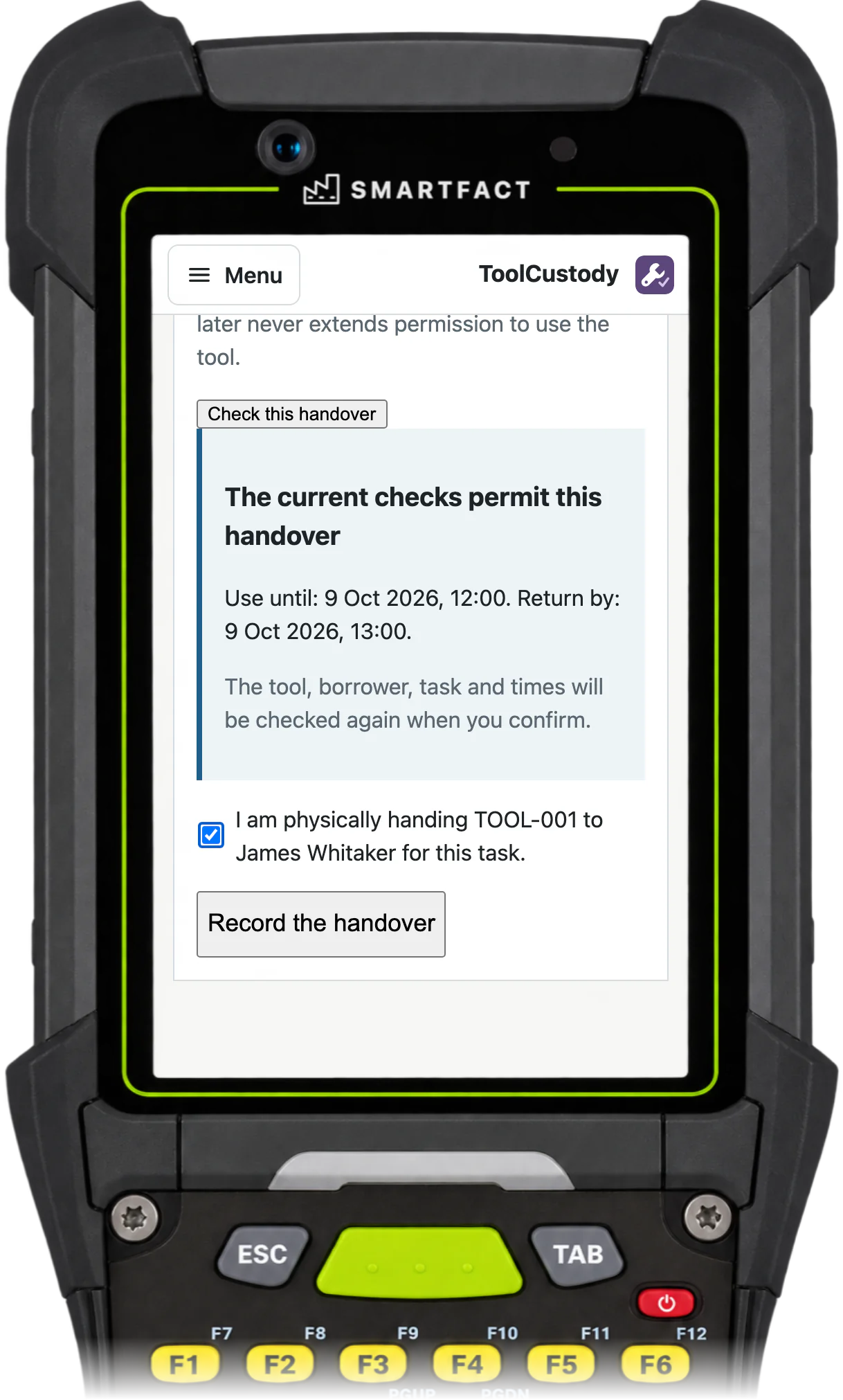
ToolCustody station showing that the current checks permit a handover, with the operator's confirmation ticked for TOOL-001 to James Whitaker and a Record the handover button
The operator confirms the physical handover once the checks pass, on a handheld or scan station.

Check-out and check-in to named people and jobs

Each tool, fixture or gauge has its own identity and one current borrower. At the crib, the operator scans it, chooses who is taking it and the approved task, and sets how long it is needed and when it is due back. Custody changes only when the operator confirms the physical handover.

When it comes back, the operator records where it was received, its observed condition and who brought it back. Returned, reviewed and put away are separate events, so a tool in the review area is never offered as one ready in the crib.
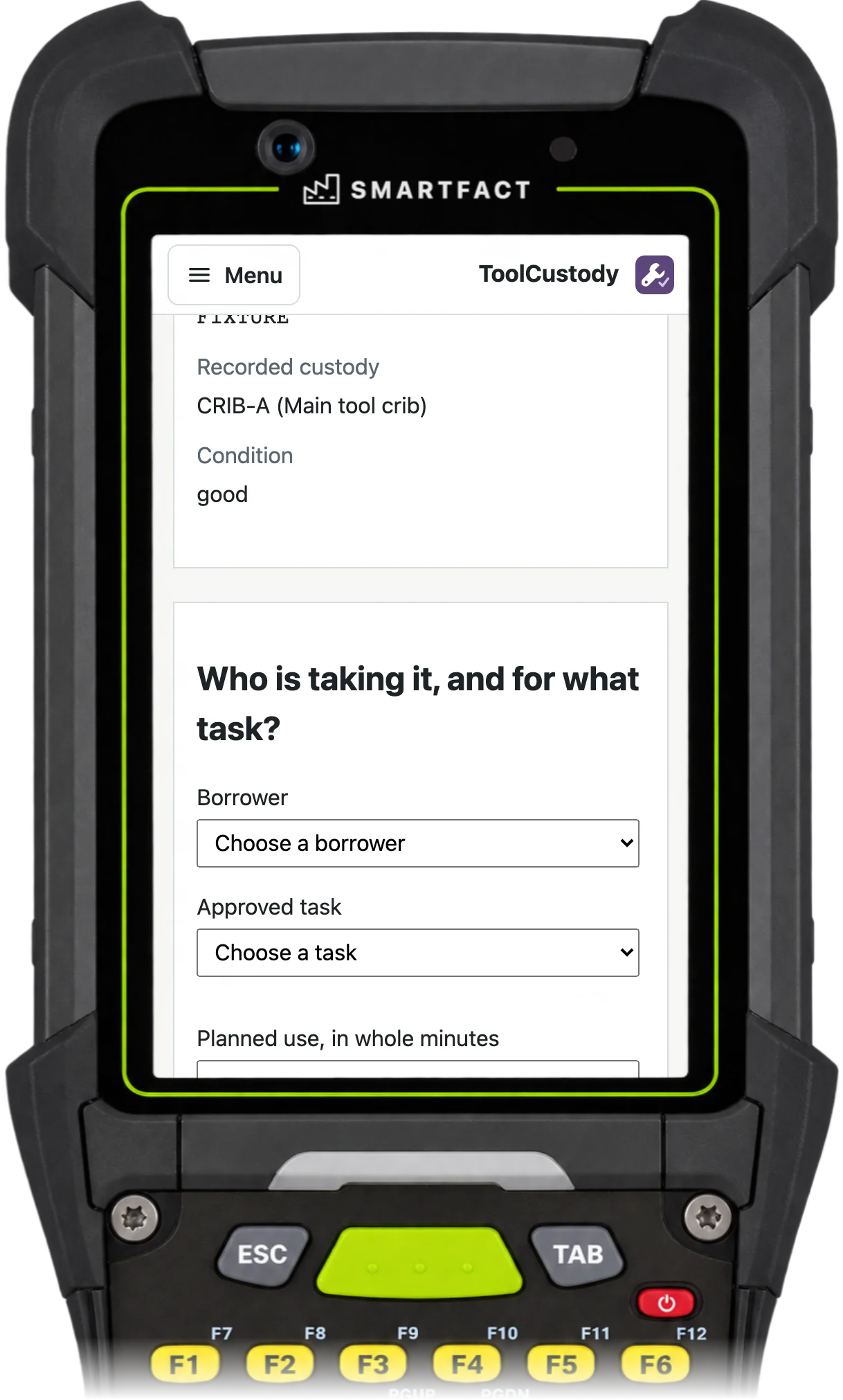
ToolCustody station after a tool scan, showing its recorded custody and condition and asking who is taking it and for what task
After the scan, the operator chooses the borrower, the approved task and the planned use, on a handheld or scan station.

Calibration checked before issue

For a task that requires calibration, the check confirms that an accepted calibration covers the task and the whole planned use. A gauge with no accepted calibration, or one that falls due before the job ends, is refused at the station. An authorised reviewer accepts each calibration record; ToolCustody does not calibrate or certify gauges.
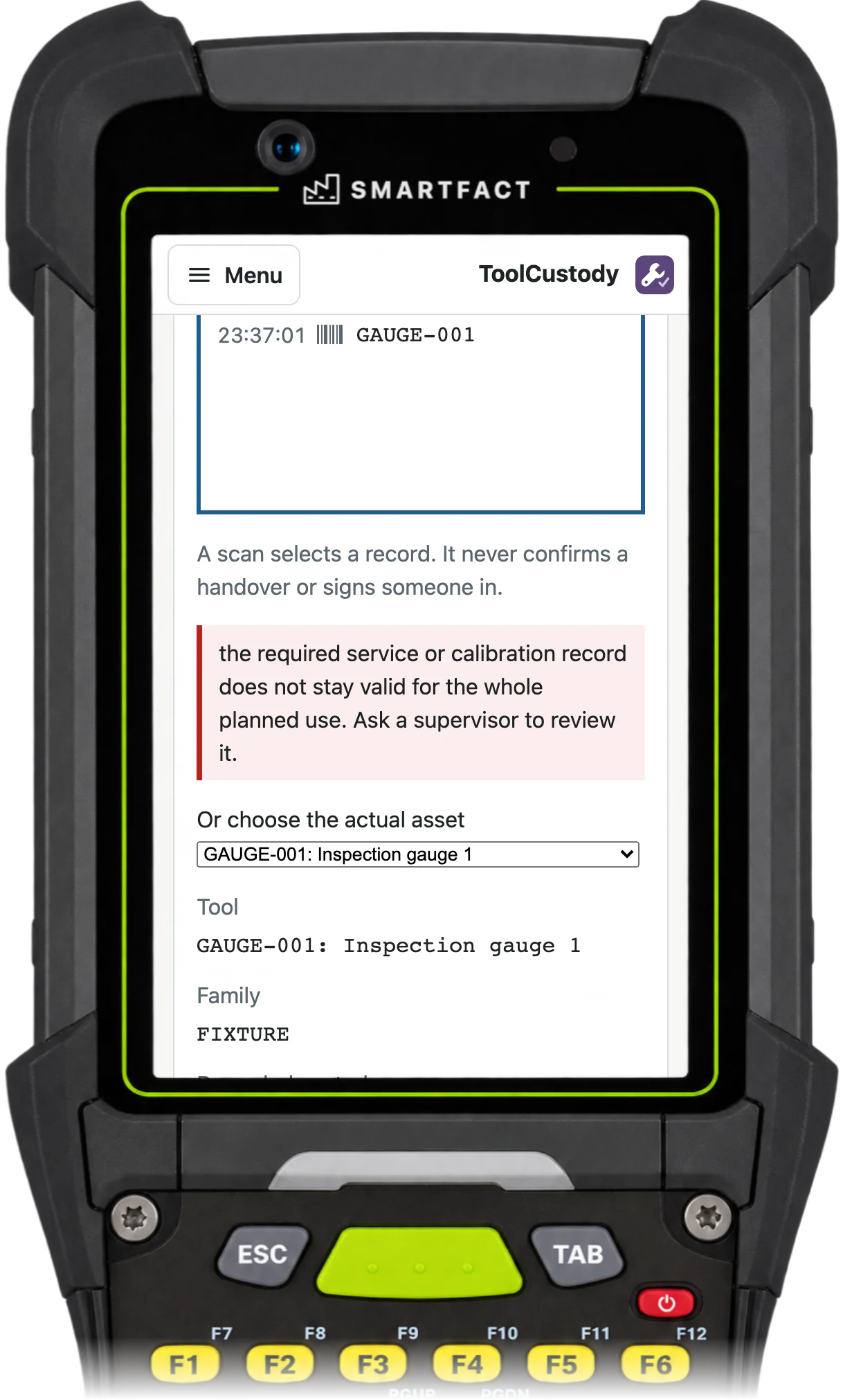
ToolCustody station refusing to issue a gauge because its required calibration does not stay valid for the whole planned use
A gauge without calibration for the whole planned use is refused, on a handheld or scan station.

Damaged returns held

A tool returned damaged is still recorded as returned, so the crib knows it is back, and it goes on hold. The next attempt to issue it is refused with the reason until a supervisor reviews it and clears the hold.
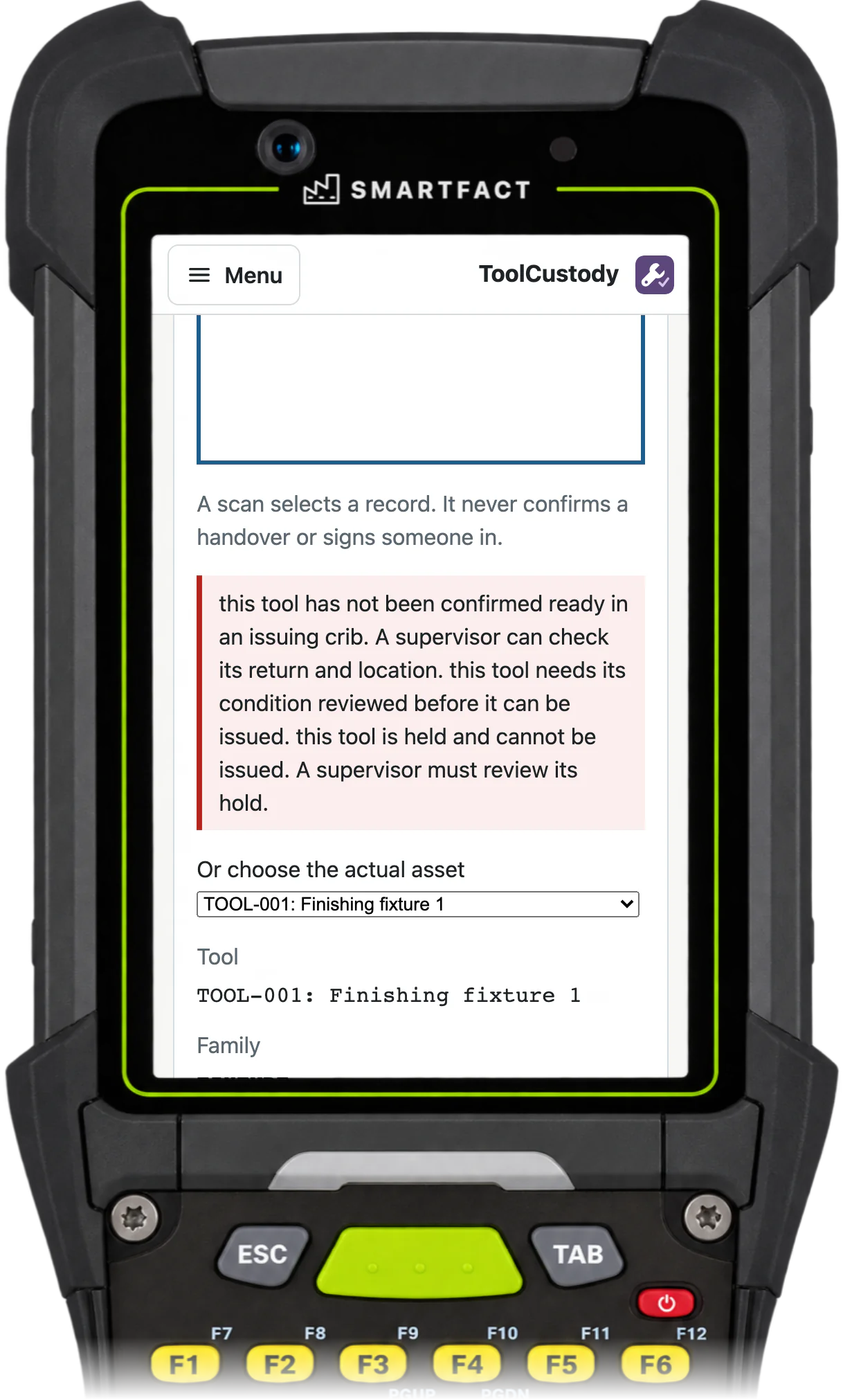
ToolCustody station refusing to issue a fixture returned damaged until its condition is reviewed and its hold cleared
A damaged return stays out of issue until a supervisor reviews it, on a handheld or scan station.

Cribs and positions

The owner records each crib and position with an exact code and a name people can match to the actual place, and a return review position is identified separately. Creating a position places no tool there: supervisors record each tool's opening position and condition before live custody starts.
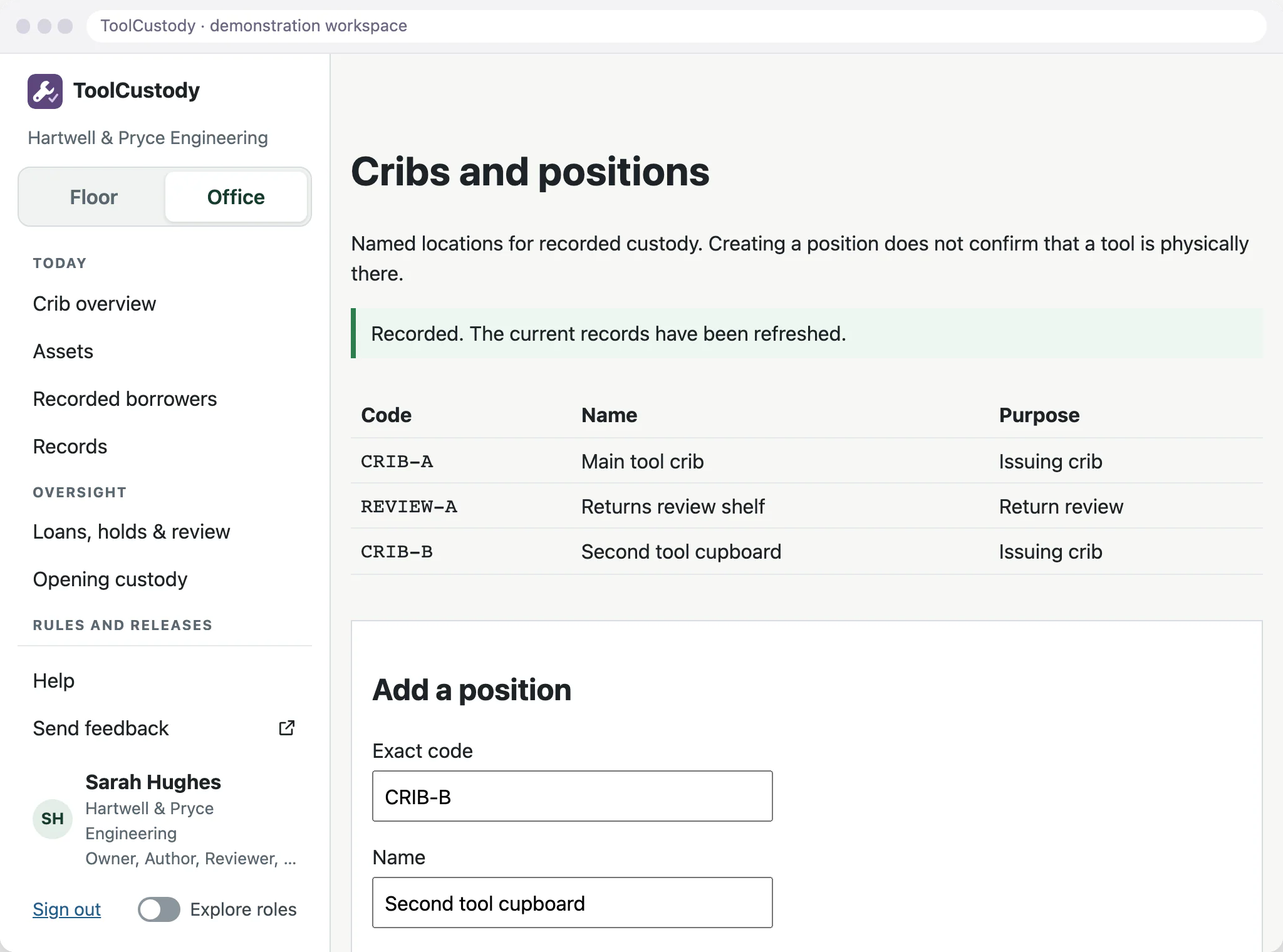
ToolCustody cribs and positions page listing two issuing cribs and a returns review shelf, each with an exact code, after a new position is saved
Issuing cribs and the return review position, each with an exact code.

Borrowers without app logins

A borrower is a custody contact, not a user account. A supervisor keeps the list of borrowers, each with an optional badge code; scanning the badge selects the borrower for a handover and never signs anyone in. People who operate ToolCustody sign in with their own SmartFACT accounts and product roles.
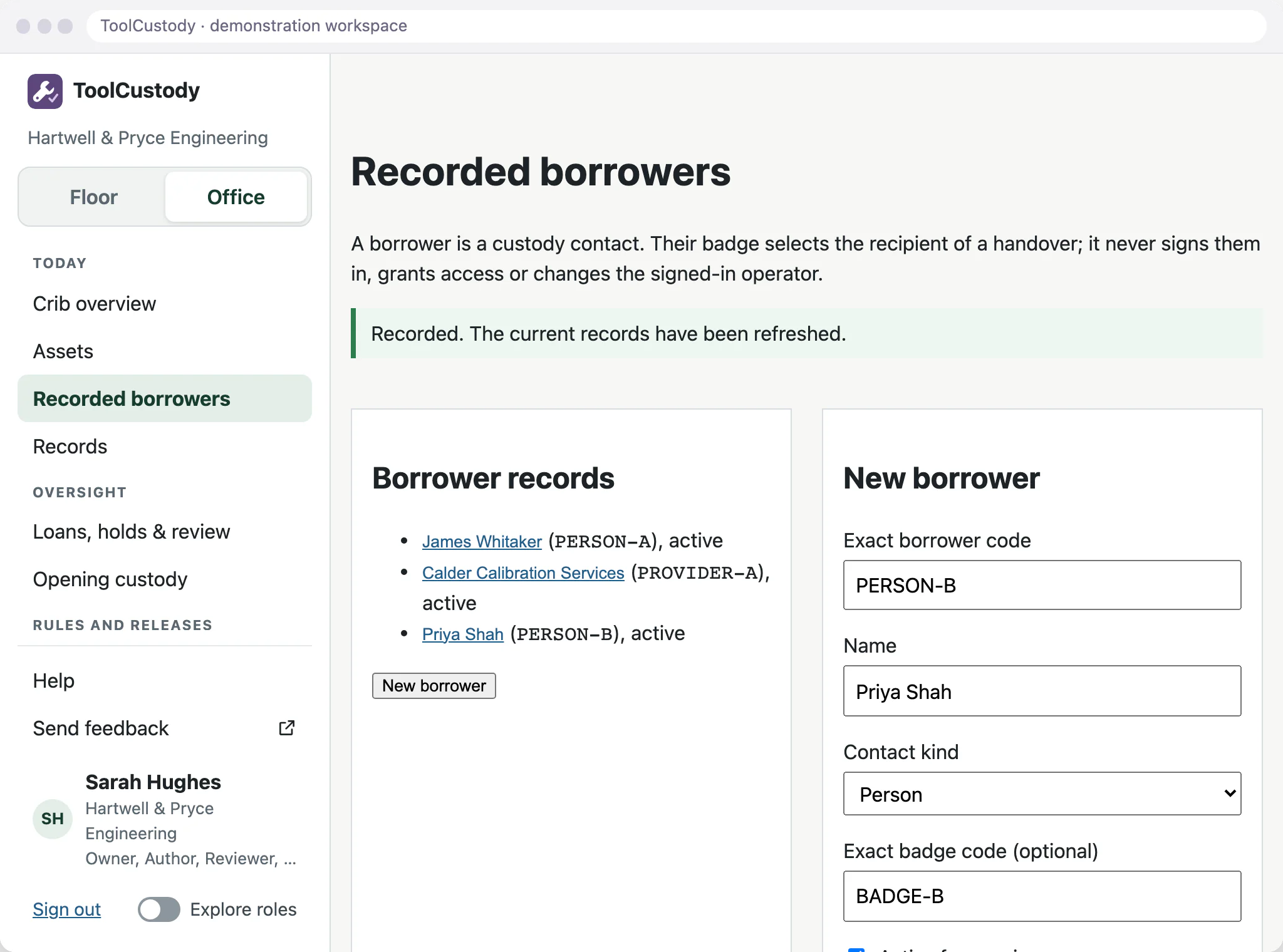
ToolCustody recorded borrowers page, with a new borrower's exact code, name, contact kind and badge code entered
Borrowers are custody contacts kept in the office, separate from user accounts.

What ToolCustody does not do

  • Consumables, stock quantities or vending. Each record is one individual tool, fixture or gauge.
  • Maintenance schedules, calibration or certificate reading. ToolCustody checks accepted calibration records at each issue.
  • RFID or GPS tracking. The record shows the handovers and returns people record, not live location.
  • Badge sign-in or self-service kiosks. A signed-in operator records each handover.
  • More than one site, or offline use.

Common questions

Is the crib staffed or self-service?

ToolCustody suits a crib where a signed-in operator records each handover and return at a station. Borrowers do not sign in, and a badge scan only selects who is receiving the tool, so it does not run an unattended self-service kiosk.

Do we need mobile barcode scanning?

You need a barcode scanner that types into the browser like a keyboard, on a handheld or scan station at the crib. Mobile camera scanning is not part of the trial offer. Test your scanner at the crib station before live use.

How do we start?

Access is by invitation only. Ask for a demonstration with fictional tools and borrowers. If it fits, we agree an invited trial for one non-safety-critical crib and enable your named users through SmartFACT Accounts. There is no payment or self-service sign-up on this website.

Trials are by invitation and start with one agreed workflow. Scope and arrangements are agreed with you before access.

INVITED TRIAL

Which tools are hardest to keep track of?

Tell us what your team shares and how issue and return work today. We arrange a demonstration and discuss whether an invited trial for one crib fits your process.

Request a trial

By invitation. No payment or self-service sign-up.

THE SMARTFACT SUITE

Useful on their own.
Better around the same floor.

Automate factory decisions with rules you describe in plain English. Explore focused SmartFACT services, plus free tools for everyday checks.

Free tool

ScannerBench

See the text and key events your keyboard scanner sends. Compare them with the value you expected.

Test a scanner
Free tool

PrintBench

Print a known PDF, measure its reference marks and compare scans from the printed codes.

Check a print
Free tool

CardBench

Create 100 × 50 mm bin and rack cards with Code 128 or QR, from one record or a CSV.

Make bin cards
Free tool

CountBench

Count stock by location with a barcode scanner, compare it with a stock file and export the results. No account needed.

Start a free count
Free tool

BarcodeBench

See exactly what a scanned barcode contains, with hidden characters shown and GS1 fields, check digits and dates explained. No account needed.

Inspect a barcode
Free tool

MatchBench

Scan a reference and each label, see an exact match or the first difference, and download the results. No account needed.

Start a free comparison
Free tool

TagBench

Scan an item or location, note what needs attention, print a review tag and keep a review list. No account needed.

Make a free tag
Free tool

FindBench

Load your own parts and locations CSV, scan a code and see every location it lists. No account needed.

Start a free lookup
Free tool

ManifestBench

Check cartons, pallets or serial numbers against a list with a phone or scanner and see what is missing. No account needed.

Start a free check
Free tool

FeedBench

Check CSV and JSON files exactly as written, preview a column mapping and compare two versions by key. No account needed.

Check a file free
Free tool

CycleBench

Time work cycles and changeovers on a phone, record interruptions with reasons and download the results. No account needed.

Start a free study
Early access

LabelRules

Describe label rules in plain English. Automatically select layouts, resolve customer codes and check each job before printing.

Explore LabelRules
Early access

KitProof

Turn plain English component rules into automatic kit checklists, then check scans against the expected parts and quantities.

Explore KitProof
Early access

WorkSteps

Turn plain English rules into automatic step selection for each unit, with required evidence and a record of completed work.

Explore WorkSteps
Early access

FactorySpec

Apply approved product rules and calculations automatically to turn dimensions and options into manufacturing requirements.

Explore FactorySpec
Early access

ConfigSheets

Maintain checked reference tables and saved versions, then prepare reviewed files for LabelRules and KitProof.

Explore ConfigSheets
Early access

OrderRun

Turn plain English rules into automatic order checks and destination selection, with controlled production release.

Explore OrderRun
Early access

ParcelOffice

Scan the work order and the parcel choice to book the courier and print the labels. Approved plain English rules recommend or choose the parcel.

Explore ParcelOffice
Early access

RefillFlow

Scan an empty container to send the right refill request to stores. Approved plain English rules set the stores queue, priority, ticket printer and escalation.

Explore RefillFlow
Early access

RemnantRack

Label each offcut, find a suitable length before cutting new stock and record what you used. Approved plain English rules decide what to keep and where it goes.

Explore RemnantRack
Invited trial

ToolCustody

Check a shared tool before handover, record who has it and keep damaged or overdue tools out of the next issue. Explore an invited trial for one factory crib.

Request a trial
Invited trial

StoresFlow

Receive, put away, reserve and issue stores material with barcode checks, keeping held, reserved and available stock apart. Explore an invited trial for one stockroom.

Explore StoresFlow
Invited trial

LotTrail

Follow a lot or serial number through the records your factory already keeps, with the source of each link and the gaps shown. Explore an invited trial with two declared sources.

Explore LotTrail
Early access

CheckStation

Scan an identified unit to get its approved final-inspection checks, then record exact readings with their result, holds and release history.

Explore CheckStation
Help

SmartFACT Help

Step-by-step guides and interactive demonstrations for the SmartFACT suite. Read the instructions, watch a task or practise with real product screens and sample data.

Open SmartFACT Help